


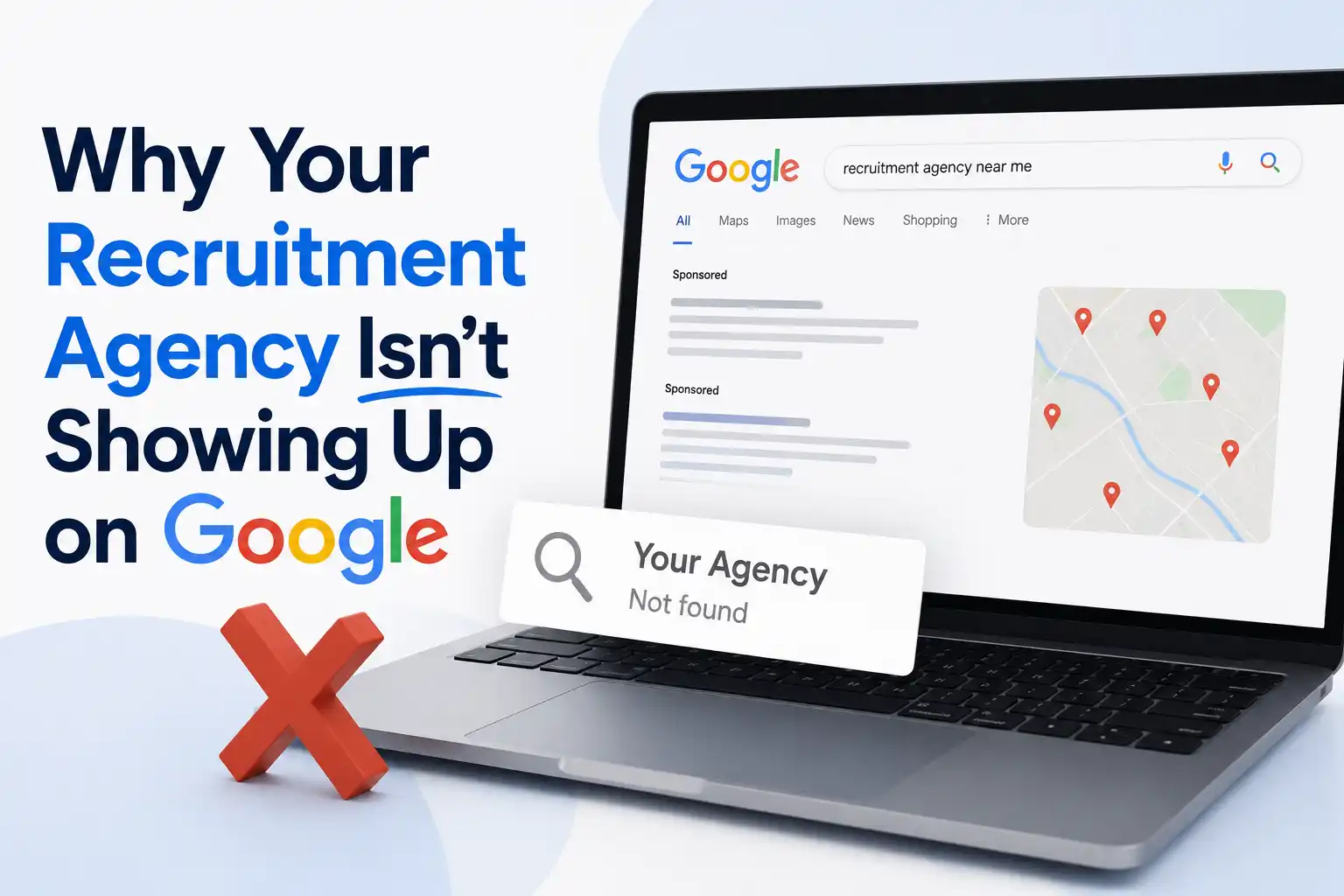
Why Your Recruitment Agency Isn’t Showing Up on Google (And What to Fix First)
You’ve got a decent website. You’ve written some service pages. Someone along the way probably mentioned keywords, and you nodded along and assumed it was being handled. And yet — when you type the kinds of searches your ideal clients or candidates would actually use, your agency is nowhere to be seen.
If this sounds familiar, you’re not alone. It’s one of the most common frustrations we hear from recruitment agency owners, and the good news is that the reason it’s happening is almost always diagnosable. The less good news is that the fix most people try first — tweaking the words on their website — is rarely the thing that’s actually holding them back.
Let’s get into it.
There are usually three culprits
When a recruitment agency isn’t showing up on Google, the problem tends to sit in one of three places: the technical foundations of the site, the content on the pages, or — and this is the big one — the authority of the domain itself.
Most agencies, when they discover they’re not ranking, focus entirely on the first two. They add keywords to their homepage. They rewrite their services pages. They fiddle with headings and meta descriptions. Sometimes this helps a little. But if the third problem — domain authority — isn’t addressed, all of that on-page work will only get you so far.
Think of it this way. Google’s job is to decide which websites to trust enough to recommend to its users. It makes that judgment using hundreds of signals, but one of the most powerful signals it looks for is this: what do other websites think of you? Are reputable, relevant sites linking to yours? Are you cited as a source worth reading?
If the answer is no — if your site is sitting there in relative isolation with few or no links pointing to it from the wider web — then Google has very little reason to put you in front of anyone, regardless of how well-written your pages are.
What backlinks actually are, and why they matter so much
A backlink is simply a link from another website to yours. When a jobs board, an HR trade publication, a business directory, or an industry blog links to your site, that’s a backlink.
Google treats these links a bit like professional recommendations. If a well-respected firm vouches for you, that carries weight. If a lot of credible organisations point to you as a useful resource, Google starts to see your site as authoritative — and authoritative sites rank higher.
The data on this is fairly unambiguous. Pages that rank at the top of Google have significantly more backlinks than pages ranking below them. The top-ranking result on any given search query tends to have a backlink profile that dwarfs positions two through ten. Research consistently shows that pages ranking at the top of Google have around 3.8 times more backlinks than pages in positions two through ten. And roughly 95% of all pages on the internet have zero backlinks — which explains why most of them never rank for anything meaningful.
For recruitment agencies specifically, this problem is particularly acute. The sector is competitive. Multiple agencies are often targeting the same geographic area or specialisms — “finance recruiters Manchester”, “tech recruitment London”, “healthcare staffing agency” — and Google has to make a call about which ones to show. All else being equal, the agencies with stronger, more authoritative backlink profiles win that argument.
Why most recruitment agency websites have weak link profiles
Here’s the honest truth: most recruitment agencies don’t think about link building, because nobody has ever explained to them that it matters.
They’ve been told to focus on their website copy. They’ve maybe invested in some SEO work that covered keywords and technical basics. But link building — the process of actively acquiring links from other relevant websites — is often overlooked entirely. It’s harder to do than on-page SEO, it takes longer to show results, and it’s easier to deprioritise when you’re busy running a recruitment business.
The result is that a huge number of agencies have websites that are essentially invisible to Google — not because the content is bad, but because no one has done the work to build the site’s credibility in Google’s eyes.
There’s also a compounding effect worth understanding. The longer a well-linked site has been accumulating backlinks, the harder it is to displace it. Competitors who started building their link profiles two or three years ago have a head start that’s genuinely difficult to overcome through content alone. Which is why the sooner you start, the better.
What good link building actually looks like in 2026
It’s worth being clear about what we mean by link building, because the term gets misused. Buying links in bulk from shady directories, stuffing your profile onto irrelevant websites, or participating in obvious link exchange schemes — these tactics either don’t work or actively harm your rankings. Google has become very good at identifying manipulative link patterns, and the penalties for getting caught are significant.
Good link building in the recruitment sector looks quite different. It’s about earning links from websites that are genuinely relevant to what you do and respected within their space. Some examples of what that might look like for a recruitment agency:
Industry publications and HR media. Getting a quote, a contributed article, or a mention in a publication that covers the world of work, hiring, or your sector specialism. A link from a credible HR or business publication carries real weight.
Professional bodies and associations. Many industry bodies — whether that’s sector-specific trade associations, regional business networks, or professional membership organisations — have websites that link out to member companies. These links tend to be highly relevant and trusted.
Job boards and recruitment directories. Being listed on well-established platforms in the recruitment space can generate valuable links, particularly if those platforms have strong domain authority of their own.
Local business citations. If your agency serves a specific region, links from local business directories, chambers of commerce, and regional media can meaningfully boost your visibility in local search results.
Original research and data. One of the most powerful link-building strategies is creating content that other sites genuinely want to reference — salary surveys, hiring trend reports, data about your sector. When other sites cite your data, they link to you naturally. This kind of earned link is the gold standard.
Guest contributions. Writing useful, non-promotional pieces for relevant publications in exchange for a byline and a link. This works best when the content genuinely serves the audience of the publication rather than just being a vehicle for a link.
The common thread across all of these is relevance and quality. In 2026, the number of unique domains linking to your site matters more than the sheer volume of links — Google values diversity of link sources over total link count. Ten links from ten genuinely relevant, authoritative websites will do more for your rankings than a hundred links from low-quality or irrelevant ones.
The other things worth checking
While link building is typically the biggest lever for recruitment agencies that aren’t ranking, it’s not the only thing worth looking at. Before investing heavily in any SEO activity, it’s worth making sure the foundations are solid:
Is your site indexed? It sounds basic, but it’s surprisingly common for websites to have settings that inadvertently block Google from crawling them. If Google can’t see your pages, it can’t rank them. A quick check in Google Search Console will tell you.
Is your content actually written for the searches people do? There’s a difference between writing about what you do and writing in a way that matches the specific language your clients and candidates use when they search. A page titled “Our Resourcing Solutions” isn’t going to rank for “accountancy recruitment agency Birmingham” — but a properly optimised page can.
Is your site technically sound? Page speed, mobile usability, and secure HTTPS connections all influence Google’s willingness to rank you. A slow, clunky website on an older theme with unresolved technical issues is fighting with one hand tied behind its back.
Does your Google Business Profile exist and is it complete? For agencies targeting a specific area, your Google Business Profile is often the fastest route to appearing in local search results. If you haven’t claimed and completed yours, do it today.
These things matter — but they tend to be ceiling-raisers rather than game-changers on their own. If your backlink profile is weak, fixing your technical SEO will help you rank better for the searches you could already rank for. It won’t vault you onto page one for competitive terms where you’re currently nowhere to be seen.
So where do you start?
The honest answer is: with a proper audit of where you currently stand.
Before investing in any SEO activity, it’s worth understanding your current backlink profile — how many referring domains you have, what quality they are, and how that compares to the agencies currently ranking for the terms you care about. Tools like Ahrefs or Semrush can give you a clear picture, or a good SEO specialist can do this for you.
From there, a link building strategy can be built around what’s realistic and relevant for your agency — whether that’s getting listed in the right places, contributing to industry publications, or creating content worth linking to.
It’s not an overnight fix. Good link building takes time to show results — typically three to six months before you start to see meaningful movement in rankings. But the effects compound. Every credible link you acquire makes the next one slightly easier to get, and the gap between you and competitors who’ve been doing this for years starts to close.
The agencies that are showing up on Google for the searches that matter aren’t necessarily doing anything dramatically different from you in terms of their service. They’ve just invested, consistently, in making sure Google knows they exist and trusts what they’re doing.
That’s a gap that’s very much closeable — but not by tweaking your homepage copy alone.
Ascendancy Media works exclusively with recruitment agencies on SEO, link building, PPC, and AI search optimisation. If you’d like to understand where your site currently stands and what’s actually holding back your visibility, get in touch for a straightforward conversation.