How We Mapped an AI Search Visibility Gap for a B2B Product Supplier
An Ascend AI audit revealed why a top-cited UK supplier was being outranked in AI search by a US competitor, and traced the gap back to a single page.
The Client
An established B2B product supplier serving several specialist commercial sectors, with strong Google rankings and a well-respected brand in its industry. They wanted to know how they were showing up when buyers asked AI tools like ChatGPT, Perplexity and Gemini for product recommendations.
The Challenge
Specifiers and procurement teams were increasingly asking AI for shortlists before ever reaching a search results page. The client needed to answer three questions: Do we appear in those AI answers? How do we compare with competitors? And where we're missing, why?
Our Approach
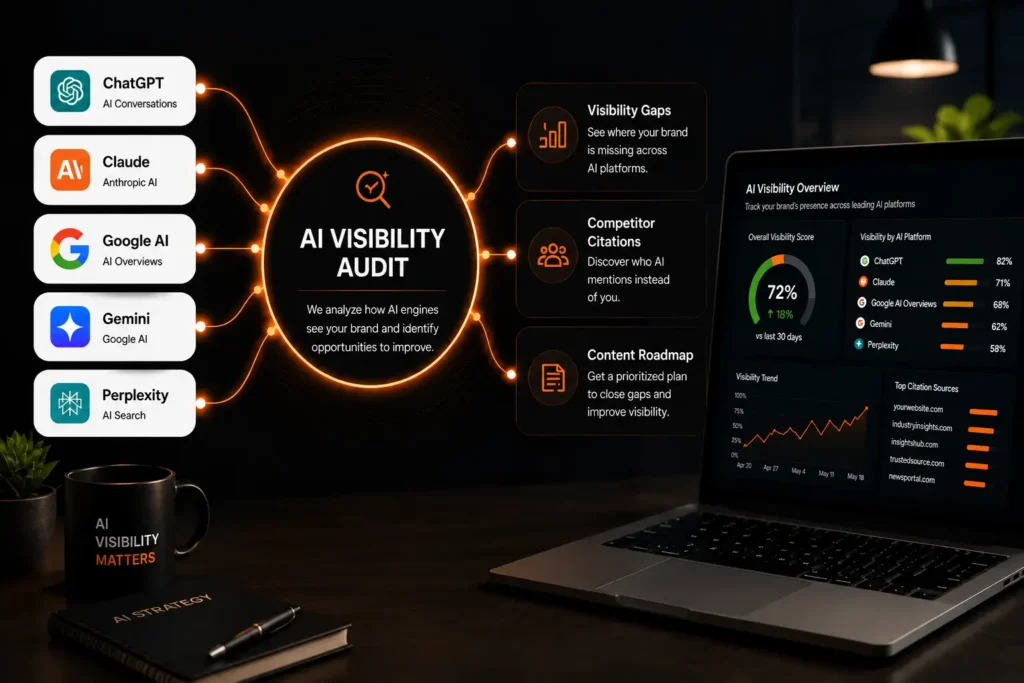
We ran a full Ascend AI Audit, tracking the brand across 48 buyer questions in ChatGPT, Perplexity and Gemini. We pulled every source URL the AI engines cited, grouped those sources into the topics that came up again and again, compared them against the client's existing content, and prioritised the gaps where the client had the right products but not the right content.
What We Found
The good news first: when the client appeared, it performed exceptionally well. It was the second most-cited domain in its market, with the best average position and the most positive sentiment of any tracked brand.
The only brand cited more often was a US competitor — in a UK-only dataset, answering questions from UK buyers. The competitor's advantage wasn't better products. It was content.
The biggest single find — We traced a large part of that advantage to one focused page on a specialist topic that buyers in a key sector were asking about. The page was retrieved 44 times and cited 73 times across the three engines. The client had the products to compete on exactly the same topic, but no page dedicated to it, so AI engines had nothing of theirs to cite.
That pattern ran wider. The client appeared in just 11 of the 48 buyer questions, and we traced the gap to two fixable causes:
1. Content gaps — The competitor had a dedicated, deeply structured page for each question AI engines were being asked. Where the client had no equivalent page, it couldn't be cited, however good its products were.
2. Technical visibility — Even where the client had strong content, its product pages carried no structured schema markup. AI engines could read the words but couldn't reliably interpret what the specification data meant. The competitor's pages were extensively marked up.
Across the market, we identified seven content clusters that AI engines repeatedly drew on, from technical specifications and sector buyer guides to compliance, sustainability and third-party editorial coverage.
The Roadmap
The Ascend AI Audit delivered a two-track roadmap: create the missing pages (built with structured markup from day one), and retrofit schema onto existing pages so the content already there becomes machine-readable. Seven actions were prioritised by impact, starting with five quick wins that could begin immediately.
Ongoing Monitoring
Citation rates and visibility are tracked across all 48 buyer questions as changes go live, with a first review after 30 days. The aim is visible movement in AI citations within 30 to 60 days.
Job Summary
Client:
Name Protected
Category:
AI Search Optimisation
Service:
Ascend AI Audit
Start Date:
May 2026
End Date:
Ongoing
Tag:
B2B Product Supplier
The Roadmap — Quick Wins
The audit identified five changes implementable immediately, before any new content was created.
Add technical specification data to every product page
Add key compliance and standards information to product metadata
Build a dedicated page for the biggest single content gap
Update page titles to include sector and product type language
Add explicit performance claims to sector-specific product pages
The Roadmap — Content Development
Alongside the quick wins, a two-track plan addressed the seven content clusters, prioritised by impact.
A dedicated page to close the competitor content gap
Sector buyer guides written around how procurement teams search
Rewrite of all sector pages as specification guides
Sustainability credentials page
Product and FAQ schema retrofitted across existing pages
Press and editorial outreach to relevant trade publications
Your competitors are already showing up in AI search results. Find out if you are too. Ascend AI maps the gaps and builds the strategy to get your business in the answer.
Specialist search marketing for recruitment agencies. PPC, SEO, and AI Search Optimisation.