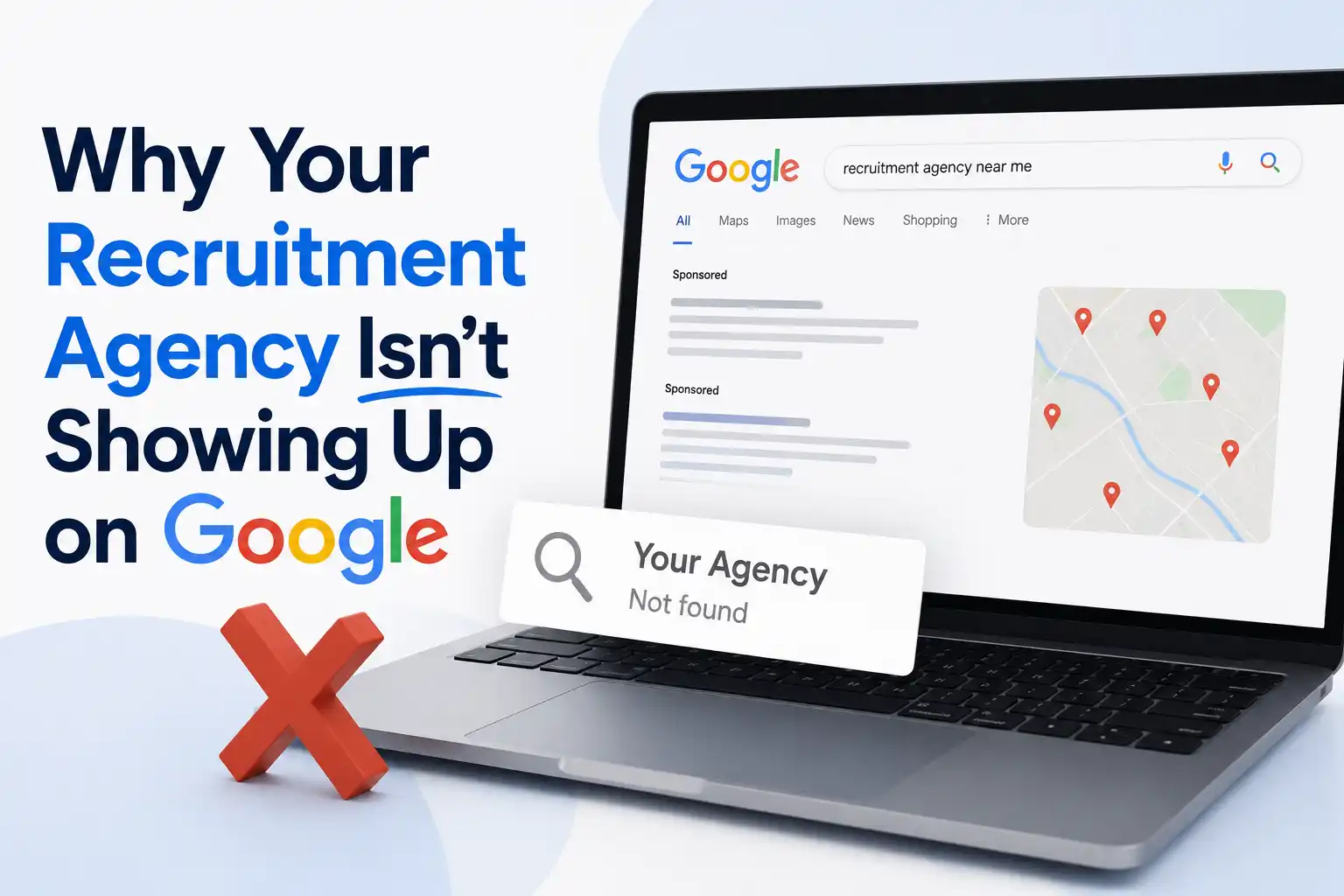



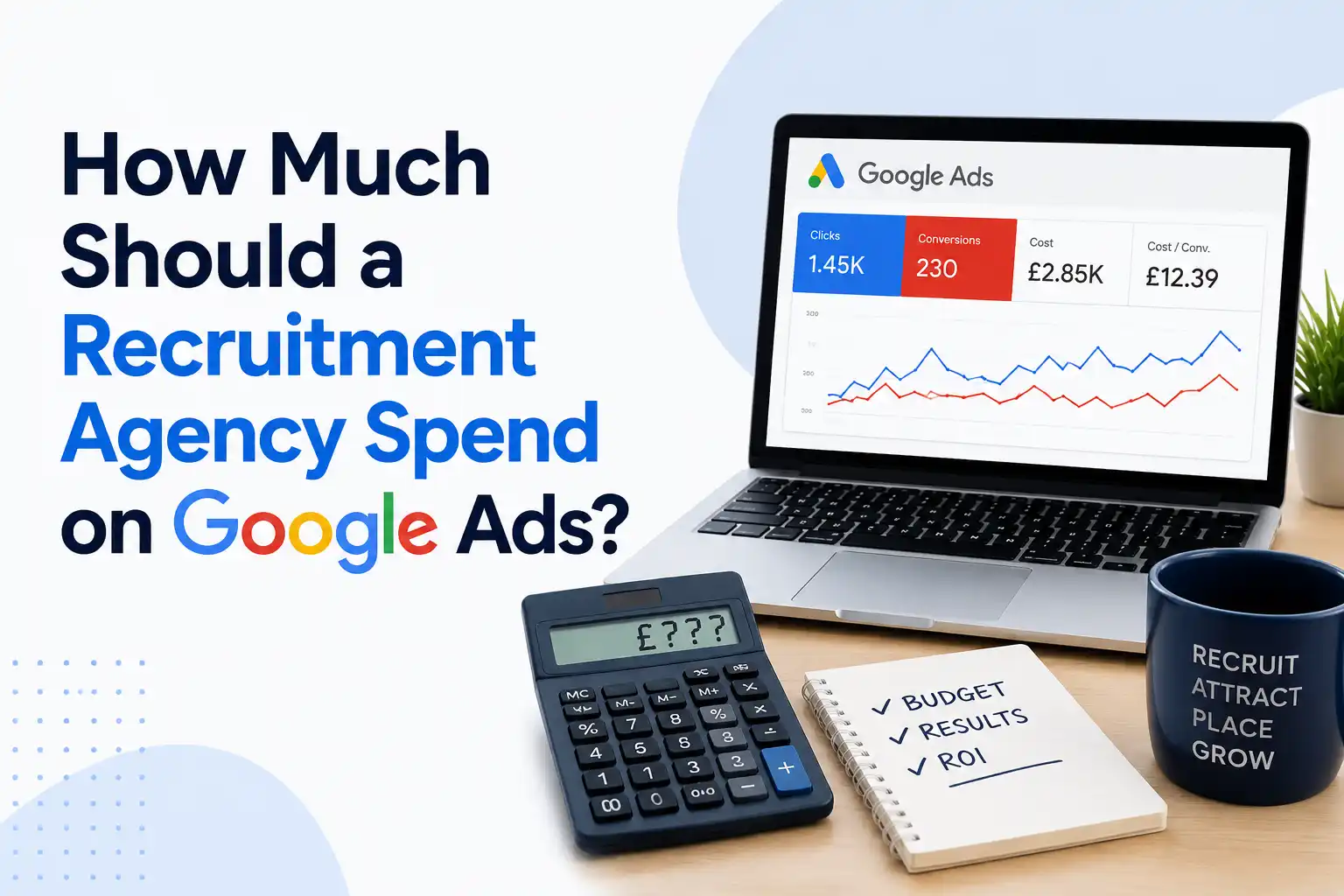
How Much Should a Recruitment Agency Spend on Google Ads? A Realistic Breakdown
If you’ve ever typed “how much should I spend on Google Ads” into, well, Google — you’ve probably landed on a load of vague answers that tell you absolutely nothing useful. “It depends on your goals.” “Start with a small budget and scale.” “There’s no one-size-fits-all answer.”
All technically true. All completely useless.
This post is an attempt to give you something more honest: a practical look at what recruitment agencies typically spend, what you actually get at different budget levels, and — crucially — why the old advice to “start small” is quietly becoming one of the most expensive mistakes a recruitment business can make right now.
First, a bit of context: the market has changed
Before we get into numbers, it’s worth talking about what’s actually happening with search right now — because it changes the budget conversation significantly.
You’ve probably noticed that search doesn’t quite work the way it did a few years ago. More and more people are getting their answers directly from AI tools — ChatGPT, Google’s own AI Overviews, Perplexity — without ever clicking through to a website. Gartner predicted traditional search engine volume would fall 25% by 2026 as AI chatbots handle queries that once drove traffic to the web. Early data suggests that prediction was, if anything, optimistic.
Google AI Overviews now appear in roughly one in four searches, and when they do, click-through rates on the results below them drop significantly. For context: a first-place organic result on Google once reliably pulled a click-through rate of 20–30%. Today, that same top spot often yields just 8–12%.
The pie, in other words, is getting smaller for organic search.
Here’s where it gets interesting for paid advertising, though. Google has moved fast to monetise AI search surfaces. Ads are now appearing in AI Overview results — up nearly 400% from where they were in early 2025. The paid results are increasingly the visible results, especially for commercial, high-intent searches. Which is exactly what recruitment advertising tends to be.
So while the organic landscape gets choppier, paid search is arguably more important than it’s ever been. That backdrop matters when we’re thinking about how much to invest.
What does “budget” actually mean in Google Ads?
Your Google Ads spend is your media budget — the money that goes directly to Google in exchange for your ads being shown. This is separate from any management or agency fees.
For recruitment, most of your spend will go on Search campaigns (text ads that show up when someone searches for something relevant — “accountancy recruiters London”, “supply chain jobs Bristol” and so on). You may also run Display or Performance Max campaigns alongside Search, but for most agencies, Search is where the real value lives.
The key metric to understand is cost-per-click (CPC): how much you pay each time someone clicks your ad. In recruitment, CPCs can range from around £1.50 to £6+ depending on your sector, location, and how competitive the keywords are. Finance and legal recruitment tends to be pricier than, say, hospitality or logistics. London will always cost more than Nottingham.
With that in mind, let’s look at what different budget levels actually get you.
Budget tiers: what you’re really buying
£500–£1,000/month — Dipping a toe in
At this level, you’re getting enough clicks to see that Google Ads works, but not enough to get meaningful data, build learning periods, or compete effectively in most sectors.
Google’s automated bidding systems — which is how most campaigns are managed now — rely on conversion data to optimise. They need volume to learn. At £500/month you’re unlikely to be generating enough to give the algorithm what it needs, which means you’re often stuck on suboptimal settings while paying a premium because your Quality Scores aren’t building up properly.
It’s also worth noting that ad auction dynamics mean budget matters. The agencies spending more tend to get better ad placements, build historical account quality, and benefit from smarter automated bidding. You can start here, but you should know you’re not yet in the game — you’re watching from the car park.
Verdict: Better than nothing, but treat this as a testing phase, not a growth strategy.
£1,000–£2,500/month — Getting somewhere
This is where things start to feel real. You’ve got enough daily spend to generate meaningful click volume, run proper A/B tests on ad copy, and begin collecting conversion data. Google’s smart bidding has something to learn from.
For a boutique agency with a tight geographic focus and a fairly specific sector, this can work well. A healthcare recruiter covering the South West, for example, might do meaningful business at this level.
For anyone trying to compete across multiple sectors or nationally, though, you’ll still find yourself bumping up against the ceiling. You’ll be showing up, but you won’t be dominating, and the agencies with bigger budgets will consistently outbid you on your best keywords.
Verdict: A decent working budget for focused, niche campaigns. Not enough for broader ambitions.
£2,500–£5,000/month — Competing properly
This is where the data starts to get interesting and the results start to feel like a proper channel rather than an experiment. You’ve got enough volume to run multiple campaigns, split-test landing pages, build remarketing audiences, and let smart bidding do what it’s supposed to do.
At this level, a well-managed account can start to deliver a genuine, measurable return. You’re visible. You’re building brand recognition in search. You’re collecting enough performance data to make smart decisions about what to scale.
For many mid-sized recruitment agencies, this is the sweet spot to aim for — or ideally, the floor rather than the ceiling.
Verdict: Solid. This is where performance starts to compound.
£5,000+/month — Where the algorithm really works for you
Here’s something that doesn’t always get talked about in polite company: Google’s platform is, to a significant degree, pay-to-play — and the more you pay (within reason), the better the system works for you.
At £5,000/month and above, a few things change:
You generate enough conversion data for smart bidding to properly optimise. Google’s Target CPA and Target ROAS bidding strategies need volume to work. More spend means more conversions means a smarter algorithm means lower cost-per-acquisition over time. It sounds counterintuitive — spend more, pay less per result — but that’s genuinely how it tends to play out.
You can own more of the auction. Instead of fighting over a handful of keywords, you can build comprehensive campaigns across candidate-facing terms, client-facing terms, branded terms, and remarketing. You’re not just present — you’re hard to avoid.
You can test properly. Landing page variants, ad copy testing, audience segments, bid adjustments by time of day or device — at lower budgets, you can’t afford to run proper experiments without starving your main campaigns. At £5k+, you can.
You build compounding advantage. Account quality scores, conversion history, audience data — these all accumulate. The longer and more consistently you’ve been advertising at volume, the better your results tend to get. Starting small and scaling later means you’ve lost months of data you can never get back.
The AI question: why now is not the time to pull back
Some agency owners, seeing the changes happening in search, have wondered whether now is a good time to reduce paid spend and wait to see how things shake out. It’s an understandable instinct. It’s also, we’d argue, the wrong call — and here’s why.
Organic search is getting harder. AI Overviews are eating into click-through rates for informational content, and the zero-click search rate is rising. For recruitment agencies, that means the “free” visibility that good SEO once provided is less reliable than it was.
At the same time, paid placements are showing up within AI search results. Google is monetising its AI surfaces aggressively, and early data suggests that ads are increasingly the visible, clickable results in a world where organic listings are getting pushed down or replaced by AI answers.
Put simply: the share of search clicks going to paid results is growing. This is exactly the wrong moment to go quiet.
The agencies that maintain strong, well-funded paid campaigns through this transition period are likely to come out on the other side with established accounts, strong Quality Scores, and conversion data that their smaller-spending competitors simply don’t have. The agencies that throttle back and wait are likely to find themselves starting from scratch in a more expensive market.
What about ROI?
This is the question that matters most, and the honest answer is: it depends on your numbers.
A quick way to sense-check a budget:
- Work out what a placed candidate is worth to you in gross profit. Let’s say £3,000.
- Work out your average conversion rate from click to enquiry, and from enquiry to placement. A reasonable starting assumption for a well-managed account might be 3–5% click-to-enquiry and 20–30% enquiry-to-placement — though this varies enormously by agency.
- Back-calculate how many clicks you need to generate one placement.
At £3 average CPC, 4% conversion to enquiry, and 25% close rate: you need 100 clicks for one placed candidate. That’s £300 in ad spend per placement, against £3,000 gross profit. A 10:1 return.
That’s a simplified example, and your numbers will be different. But it illustrates why the question isn’t really “how much should I spend?” — it’s “what return am I generating, and how do I maximise it?”
The answer to the second question, almost always, involves spending enough to let the platform perform properly.
A quick word on management
Budgets matter, but so does what happens to them. A poorly managed £5,000 account will outperform a brilliantly managed £500 one — but it won’t outperform a brilliantly managed £5,000 one.
If you’re working with an agency or specialist, make sure they understand the recruitment sector. Generic PPC management often misses the nuances of candidate vs. client intent, seasonal patterns, and the specific way recruitment search behaviour works. The keywords, the match types, the landing page strategy — it all needs to be built around how recruiters and candidates actually use search, not just how search works in general.
So, what’s the number?
If we had to give you a straight answer:
For a boutique agency with a focused niche, £2,000–£3,000/month is a realistic starting point. You’re generating enough volume to learn and optimise, and with smart management, you should start seeing returns within 90 days.
For agencies with broader ambitions — multiple sectors, national reach, or growth targets that actually mean something — £5,000/month is where we’d encourage you to aim. Not because bigger numbers are better for their own sake, but because that’s the level at which Google’s tools work properly, your data compounds, and you’re genuinely competitive in the auction.
And given where search is heading — with paid results increasingly visible in an AI-influenced landscape — the time to build a strong paid search presence is now, not after everyone else has already done it.
At Ascendancy Media, we work exclusively with recruitment agencies on PPC, SEO, and AI search optimisation. If you’d like an honest conversation about what a realistic budget looks like for your agency, get in touch.